
Yuwa: Where Girls Kick Off A Revolution
- Debjoy Biswas
- Feb 1
- 5 min read

Updated: Feb 3
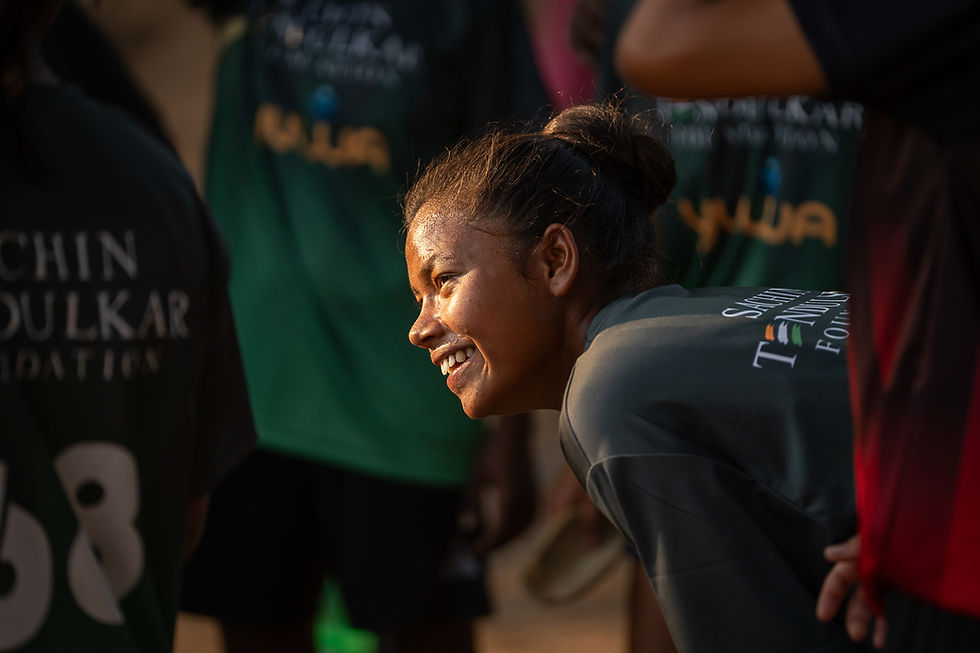
"Today, I’m a strong and intelligent person. Once I joined Yuwa, so many doors were opened to me," says Punam, a Yuwa player since 2013, now a coach and life skills facilitator. "I became confident and had the opportunity to travel. I’ve been a football coach and a life-skills facilitator. I was elected Prime Minister of Yuwa Student Parliament this year, which has been the biggest achievement of my life. I’m really really proud of myself." The words came softly, but with purpose. In the heart of rural Jharkhand, where dust clings to morning dew and dreams are usually handed down, we found something rare: a quiet revolution being led by teenage girls with cleats on their feet and purpose in their stride. This is the story of Yuwa. For most of India, football is still considered the 'other sport', and for girls in places like Ormanjhi, it wasn't even an option. Until Franz Gastler arrived.
Opening Whistle Back in 2008, Franz, a Minnesota-born consultant and Boston University alum, found himself disillusioned with corporate philanthropy models. Looking for something real, he moved to rural Jharkhand and started teaching English in a school. Franz recalls, “I was playing football with a group of boys in the monsoon… then I proposed a football tournament for boys and girls. More than 100 girls showed up. The next day, not a single boy turned up except the organizers.” "We had 100 medals and we ran out. I knew then something big was happening. These girls weren’t just showing interest; they were igniting a revolution." “I understand from my academic background that if you invest in girls, you get a very high return on that investment in terms of development impact. The boys already played. But these girls were eager to learn. And passionate. So I started coaching them.” He thought they’d lose interest after a few weeks. They didn’t. Practices began before sunrise, lit by the headlight of Franz’s motorcycle. “The girls were bringing themselves to practice every single day. It was the first time I felt something truly impactful was unfolding,” he says. Resistance came later from families who needed the girls at home, or from men ridiculed because their daughters were wearing shorts and chasing footballs. Franz’s answer? Keep showing up. From the sidelines of that dusty pitch to the nerve centre of a social movement, what Franz started wasn’t just sport—it was cultural intervention. As I sat across from him in Ormanjhi during our chat, I couldn’t help but notice the calm intensity in his voice. This wasn’t a man selling impact metrics. He was recounting lived transformation. “The girls didn’t come because we asked them to. They came because they wanted to. And that made all the difference.”

Coaching as Culture
Franz wasn’t just teaching skills. He was shaping dignity. “No laps. No lines. No lectures. I wanted the girls to feel proud every time they left the field. The coach is a guide on the side, not a sage on the stage.” He spent seven years coaching every day, building a female coaching cadre from scratch. “It was the only way to keep the space safe, scalable, and sustainable.” And the result? A movement. “Some NGOs use football as bait. But our girls came because they loved the game. If we didn’t respect that, we’d be failing them.” Franz saw himself in their struggles. “I’ve been the worst and the best on a team. I know what good coaching can do.” We spoke about some of the hardest games. The ones they lost. The emotional backlash. The cold silence post-match. “You know,” he said, “sometimes they just need to be told it’s okay. That the value isn’t in the scoreline. It’s in showing up.”
From Harvard to Jharkhand
“The big wins, Harvard admits, international tournaments - they bring relief, not pride,” Franz says. “The pride comes when I see our coaches running great sessions, our girls enjoying learning. That’s when I know this is working.” He doesn't put prestige above people. “Some state and national teams are poorly run. What matters is whether our girls feel safe, respected, and seen.” He smiles when recalling one girl who made it to Harvard. “She brought a perspective no one else had. I told her: I would’ve loved to be your classmate.” The dream is bigger than sport. “I want our girls to be global voices. When someone speaks once, the next opportunity goes to someone new. Everyone deserves the mic.” One of the moments that struck me the most was when he said, “When I walk into school and see incredible teaching or onto the pitch and realise there’s nothing for me to fix, that’s real impact.”
Yuwa as a System
Football was the spark. But education was the fuel. In 2012, Rose Thomson Gastler joined Yuwa. With a Walker Fellowship and a fire for empowering girls through sport, she quickly realized football alone wasn’t enough. “These girls were hungry to learn, but the schools were failing them,” she says. “They were waking up at 4 AM for football and tuitions, but still falling behind. They had no real pathway to quality education.” So Rose co-founded Yuwa School in 2015. “The girls asked for it. We listened. We built it.” Today, the school blends academics with essential life skills: menstruation, relationships, financial literacy, self-esteem, consent. “Things no other rural school dares to teach.” Small class sizes. Empowered teachers. A leadership pipeline where former players become coaches. “One girl froze during a school speech and sat down crying. Another girl hugged her. Minutes later, she got back up and finished her speech. That’s Yuwa. That’s sisterhood.” The Coaches Development Program, started out of necessity, became a legacy. “Girls coach girls. Boys look up to female leaders. That’s how gender roles shift.” And the gains go far beyond football. “They learn communication, group management, professionalism—skills they’ll carry into any career path,” Rose notes. There’s no condescension in how Rose speaks. She doesn’t call them ‘underprivileged.’ She calls them brilliant, hardworking, and honest. “They’re the ones who built this school with us,” she told me.

Life Beyond the Game
Ankita (Head of Life Skill Program) recalls a match in Koderma. "Our girls won. The losing team refused to shake hands. Our players sat with them, shared how they once lost too, and encouraged them to keep going. That’s Yuwa." Perhaps the greatest validation comes not from institutions, but from home. "Today, parents are asking, 'Why isn't my daughter in the Jharkhand team?' That’s revolutionary," said Niharika (Child Protection Officer). "We used to hide football kits. Now we celebrate them." The Indian women’s football scene still faces hurdles. But the tide is turning. Clubs like Odisha FC and Gokulam Kerala FC are raising the bar. Even the Jharkhand government is exploring partnerships with Spanish clubs for youth academies. Ankita says, “Now girls come back from national camps and say, ‘Next time, I’ll be stronger.’ That’s growth.”
The Final Whistle
Yuwa doesn’t chase medals. It nurtures voices. Franz gave them the ball. Rose gave them the classroom. Yuwa team gave them reflection. And the girls? They gave the world proof of what’s possible. At dawn, on a dusty field, a quiet roar begins. No stadium. No spotlight. Just girls, running toward a dream. And laughing—loud, free. Sometimes, revolutions don’t begin with fire. Sometimes, they begin with football.

Pixel Sports thanks Yuwa, Franz, Rose, Ankita, Niharika, Punam, and every Yuwa girl for reminding us what strength, sisterhood, and sport can build.
Image Courtesy: Yuwa


Comments