
From Japan Boardrooms To Bihar's Fields: The Story Of Nozomu Hagihara
Updated: Feb 3

When Nozomu Hagihara first left the polished glass towers of Toyota and landed in Bihar, it was supposed to be temporary. A government assignment, a brief chapter, a line on the CV. But sometimes football rewrites the script. It began with one ball. Bought on an ordinary day, kicked on dusty ground, it attracted children from the village barefoot, wide-eyed, restless for play. In that moment, Hagihara saw what others didn’t: not a place with “nothing to do,” but a land filled with untapped possibility. Years later, he is no longer the visiting corporate professional. He is the man behind FC Nono, a project where football is less about producing stars and more about producing confident, resilient human beings. His journey has taken him from J-League academies to juvenile homes, from 2,000km dribbling marathons to convincing skeptical parents that daughters belong on the field. This is his story in his own words as told to Pixel Sports.
Pixel Sports: You’ve gone from corporate boardrooms at Toyota to dusty football fields in rural Bihar. Can you take us back to that moment when you knew this was more than just a side project that this was your true calling?
Nozomu Hagihara: The turning point came when I started noticing small but powerful changes in the village children who joined my training sessions. Their eyes lit up with confidence, their discipline improved, and they carried themselves differently — not just on the pitch but at home and school. At that moment, I realized that football, which had been my personal passion for nearly two decades, could be a tool to transform the lives of others. I also understood that my corporate background in project management, communications, and the ability to bring people and sponsors together was not separate from this mission but actually essential to it. Combining my “passion: football” with my “strength: influence and execution” in service of children became not just work, but my purpose. That was the moment I felt this was my true calling.
PS: Nineteen years of playing football, including your time at J-League’s Oita Trinita U-18, how did that journey on the pitch shape the way you now use sport as a tool for social transformation?
NH: Many imagine a professional academy as glamorous, but my experience at Oita Trinita U-18 was closer to military training than luxury. Running 10 kilometers to the ground, practicing until exhaustion, watching teammates collapse during physical sessions — it was brutal. But within that hardship I learned lessons no classroom could teach: to persist when everything hurts, to honor promises, to lift up teammates through action not just words, and to push boundaries of discipline. Japan often treats sport as “sports for excellence,” aiming at performance. Yet I discovered that striving for excellence simultaneously teaches “sports for development”: resilience, integrity, empathy, teamwork. These lessons are what I carry into Bihar — where football is not about producing stars, but about producing strong, confident human beings.
PS: When you first arrived in Bihar, you’ve said there was “nothing much to do.” Yet you saw something that others didn’t. What was that spark, that potential, that made you stay and build?
NH: I originally came to Bihar for an agricultural project with the Japanese government. Unlike Japan, there were no bars after work, no shopping malls, no distractions. Life felt empty outside the office. One day I bought a football, just to move my body again — and within minutes, children surrounded me, curious and eager to play. That moment, seeing how a simple ball could bring joy, connection, and energy, was the spark. I stayed because I realized the children were not lacking in potential; they were lacking in opportunities. Football became the bridge to create those opportunities.

PS: The “Kids’ Coaching Project” is fascinating — turning your own players into coaches for the next batch. How do you strike the balance between empowering these young leaders and ensuring the football stays at a high standard?
NH: For me, leadership is not taught in a classroom — it is forged by responsibility. When our kids coach younger ones, they start reflecting on their own learning, translating skills into words, and modeling discipline. That process deepens their own understanding. Of course, they are still players themselves, so we keep enough time for their personal development. Currently Kids’ Coaching happens only once a week, so the balance remains healthy. I actually see it as a win-win: they grow as leaders without compromising their growth as athletes, and the overall quality of football improves because teaching requires clarity.
PS: You work with juvenile prisoners, orphans, and kids from economically fragile backgrounds. How do you adapt your training methods for such different — and often vulnerable — groups?
NH: The philosophy is the same: joy first. But I tailor the method to each context. Juveniles often have overwhelming energy; I channel that into competition — longer relays, team races — where they can burn energy while learning teamwork. Orphans, some carrying trauma, need a different approach. For them, I design individual skill challenges — dribbling through markers, juggling — where progress is measured against their “yesterday self.” That builds confidence, and confidence eventually allows them to re-enter relationships. These adjustments are not perfect formulas, but small, thoughtful changes make vulnerable children feel seen, respected, and capable.
PS: Then there’s your partnership with JICA and Yakult for the “Achhi Aadat Campaign.” Mixing Japanese corporate discipline with grassroots Indian football isn’t an obvious pairing — what unexpected magic has come out of it?
NH: The magic lies in localization. Japanese companies come with strong content and expertise — health, hygiene, discipline — but without local partners it can feel distant. By combining their resources with our grassroots football environment, children receive lessons in a way that feels natural and fun. Instead of lectures, hygiene becomes part of play; discipline becomes part of teamwork. This hybrid of Japanese precision and Indian grassroots spirit creates an unexpected harmony that neither side could achieve alone.
PS: Bihar’s sex ratio is 918. Convincing families to let their daughters play football isn’t easy. How do you win those conversations in living rooms and village courtyards?
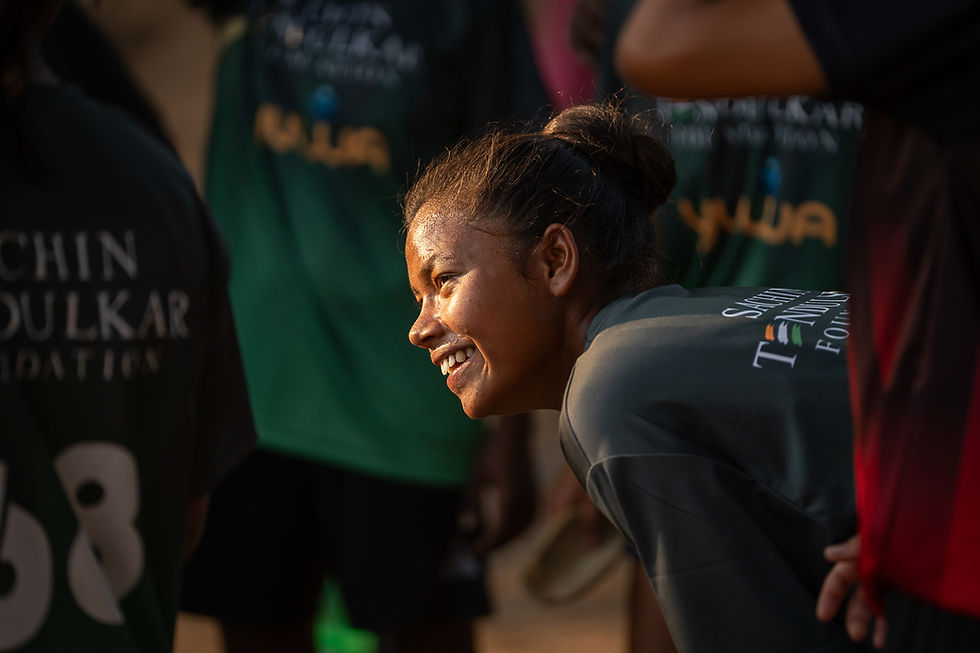
NH: This is perhaps the toughest challenge. Parents worry for valid reasons: loss of time for chores, risk of harassment, fear of distraction from studies. We cannot dismiss those fears; we must answer them. For example, when chores become an issue, I encourage brothers to take responsibility — reminding families that gender equality requires boys’ involvement too. For safety, we keep strict schedules, ensuring girls return home early and move in groups. The most powerful shift came when we invited two of the most skeptical mothers on an away trip to Jharkhand’s Yuwa Foundation. They lived alongside their daughters, saw role models, and felt the safety and pride themselves. That experience turned them from skeptics to supporters. Sometimes, to win families, you must first win their hearts.
PS: You still juggle your work at EY, run FC Nono, and keep your ties to corporate Japan. How do you take the precision and efficiency of Japanese corporate culture and make it work in rural India?
NH: I’ve since left EY, but I continue working with Japanese HR companies as a freelancer while running FC Nono. Japanese-style project management — planning, scheduling, risk-mapping — helps, but in rural India rigidity often fails. The bigger skill is adaptability: understanding that the power may cut, the roads may flood, and still moving forward. Japanese efficiency gives me structure, but Bihar teaches me flexibility. Together, they form a balanced way of working.
PS: You’re planning to take 20–30 kids from Bihar to Japan. What do you think will surprise them most about Japanese life — and what do you think Japan will learn from these kids?
NH: They’ll be amazed by how clean Japanese streets are, and by how deeply civic sense is embedded in daily life — lining up, keeping silence on trains, respecting public space. But Japan will also learn from them. These children bring an energy that comes not from material wealth but from community strength and joy in simplicity. They remind us that human connection, not consumption, defines a rich life. The exchange will challenge both sides to rethink what “development” really means.
PS: Having immersed yourself in Bihar’s rural reality, has it changed how you see Japan’s own approach to community building and corporate social responsibility?
NH: Absolutely. In Bihar, development is not abstract — it’s visible in how a child grows in confidence, or how a family allows a daughter to step outside. CSR in Japan can sometimes feel like a checkbox exercise. Bihar has reminded me that true responsibility means empowering individuals to stand on their own feet, to make choices, and to take actions that ripple outward. It has made me more critical, but also more hopeful, about how Japan can redefine CSR as genuine empowerment.

PS: If you were to replicate FC Nono’s model somewhere else in India — or even in another country — what are the three things you would absolutely never compromise on?
NH: First, child-led initiatives like Kids’ Coaching — because leadership must be practiced young. Second, engaging men and boys — because gender equality is impossible without their buy-in. Third, depth over numbers — we don’t chase how many children join, but how deeply one life can change. Those three principles are non-negotiable, wherever we go.
PS: Let’s talk about that 2,000km dribbling journey. From 25km a day to 165km — where did your body and mind almost give up, and what kept you moving?
NH: My mind never broke, because constant motion released endorphins that kept me positive. Physically, it was painful every single day. But I had promised the children, and as a role model, I couldn’t break that. Every step was fueled by the thought: “If I stop, I betray their trust.” That sense of responsibility was stronger than any physical pain.
PS: You’ve said you broke into tears the first time you hit 100km in a single day. What was running through your head at that moment?
NH: Gratitude — for my team, for supporters, for the children waiting. Relief — that I had actually reached the goal I set. And pride — not arrogance, but deep pride in myself for honoring my word. Those tears were everything mixed together.
PS: You have strict rules like 80% attendance before the girls can travel for matches. What kind of pushback have you faced from families, and how do you navigate those deeply rooted cultural hesitations?
NH: Surprisingly, almost none. Because the rule is equal for everyone — no favoritism, no exceptions. Families respect that fairness. It turns discipline into a shared value, not a punishment.
PS: Finally — ten years from now, when you look back at this chapter of your life, what’s the one picture you want to see in your mind and say, “Yes, I did it”?
NH: I see a full-residential academy in Bihar — not just any academy, but one of the highest quality in the world. Children there not only master football but also fall in love with learning, feel safe with every adult around them, and graduate as independent individuals — emotionally resilient, financially stable, and ready to give back to their families, communities, and country. That vision is the picture I want to carry in my heart.

Image Courtesy: Nozomu Hagihara


Comments