
From Sonipat to Stardom: Abhishek Nain’s Golden Chase
Rajgir’s scorching heat couldn’t stop him. Neither could the childhood injury that almost ended his journey before it began. Abhishek Nain, the boy from Sonipat who once played hockey just to escape the boredom of classrooms, now stands as Asia Cup’s Man of the Tournament. His story is stitched with discipline, the faith of a Hindi teacher who became a coach, and the stubborn joy of chasing a ball across the turf. In this conversation, Abhishek opens up about his early struggles, the role of mentors, the influence of Cristiano Ronaldo, and his dream of bringing back the golden age of Indian hockey.

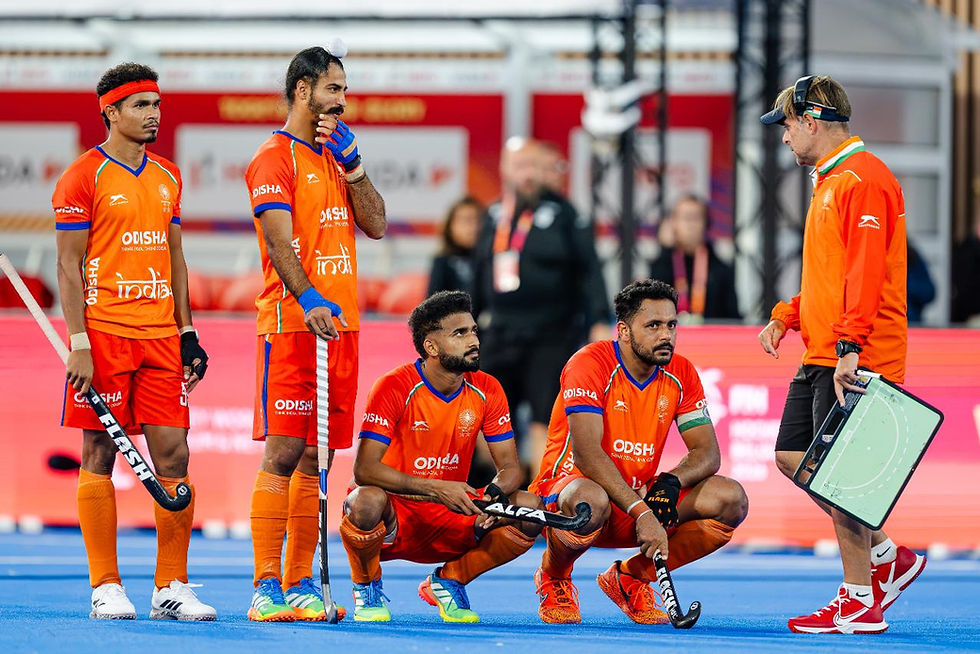
Photo by Debjoy Biswas/Pixel Sports
Pixel Sports: Firstly, many congratulations on winning the Asia Cup and being named the Man of the Tournament.
Abhishek Nain: Thank you so much.
PS: How was the experience in the Asia Cup? How was Rajgir, Bihar?
AN: The experience was very good, but it was extremely hot. Seeing the people who came to support us gave us motivation. The weather was tough, but the fans were crazy about hockey! They were different, they were passionate fans!
PS: In your childhood, you suffered a serious injury even before your career began. How did that experience shape your perspective on life and hockey?
AN: At that time my hand was completely cut. I was climbing down from a wall with glass, and I injured myself badly. My family wanted me to give up hockey because I was always getting hurt and I was very mischievous. But my first coach came to our house and told my family that I could be a good player with a bright future, so they should enrol me in coaching. I still speak to him; he keeps motivating me and tells me that I’m finally reaping the fruits of my labour, so I must stay disciplined. Whenever I feel demotivated or unwell, I call him, and he helps me a lot.
PS: Your first coach – Samsher Singh Dahiya?
AN: Yes, yes!
PS: Samsher ji didn’t have a formal hockey background?
AN: No, he was our Hindi teacher.
PS: So how did this unconventional coaching come to be? How did it start?
AN: This happened at our school, which had a hockey programme. Samsher ji cared deeply for his students, so one day he came to the ground just to watch us play, and no one was there to coach the kids. He took charge, disciplined us, and made it a routine to visit daily. He asked the senior players present on the ground to help us practise. Although he had no hockey experience, he followed the seniors’ guidance and made it part of his daily routine to coach us – and that’s the result.
PS: You have said on multiple occasions that hockey was your escape from studies because you lacked patience for them. So how did you transform this lack of patience into a disciplined game like hockey?
AN: Playing was fun, and it keeps the body fit. When I was sitting in class, I used to get bored; it wasn’t fun. Playing with teammates was enjoyable, and both winning and losing bring their own thrill. I began playing hockey after seeing a classmate play; he eventually quit, but I continued because I loved it. Winning or losing, it was all fun, and my coach kept motivating me and giving me opportunities to play, so I left my studies and pursued hockey.
PS: You are a football fan and specifically a Cristiano Ronaldo fan. What aspect of Cristiano Ronaldo inspires you the most?
AN: His hard work and consistency. Staying disciplined and believing in yourself, the feeling that ‘I can do it’ and ‘I am the best player’ inspire me a lot. Especially his consistency; it inspires me very much.
PS: Now, coming to the formative years of your career, before representing Punjab National Bank you represented East Bengal Club. How is the atmosphere of club hockey and how is it different from international hockey?
AN: Club hockey is very different. The age groups vary. Some players are seniors, others very young, so maturity differs at the domestic or club level. Some may be fit, others not, so players must play to their strengths. The international level, however, demands both stamina and speed. The international game is overall faster; at the club level, if your speed is lacking but you have experience, you can manage. At the international stage, you need everything – that’s a different level.
PS: Speaking about club hockey, in the Hockey India League you are now the second highest paid player. How do you handle the pressure and expectations?
AN: Yes, but when I step onto the ground, a different motivation kicks in because I play every game as if it’s my last. Who knows if I’ll play the next match or not? I enjoy the game because from the start I have loved hockey. As soon as I become too serious on the ground, I begin to feel pressure, but when I enjoy myself and chat with my teammates, I thrive. When I feel pressure, I talk on the field to release it, and if I make mistakes, I focus on playing simple hockey. That’s it.
PS: At the beginning of your career, when you were constantly getting in and out of the senior team, you had to train alone, but you had your teammate Vivek Sagar Prasad training with you. How difficult was that period, and how did this partnership with Vivek help you?
AN: When I was a junior, I was dropped from the senior camp. My name wasn’t there because of some issues with the Junior World Cup. But Vivek Sagar Prasad was in the senior camp at that time, so I used to take his schedule for gym and conditioning. With his help, I would practise at Punjab National Bank or do personal practice and gym sessions. I followed the senior camp’s schedule by asking him for it, and I always tell Vivek that I haven’t forgotten his help. Thanks to him, I made it into the senior camp in 2022. When I joined the senior team, I never felt slow or weak; I felt comfortable and confident that I belonged there.
PS: Since 2022, you have been an established starter and a premier forward. So, how do you mentor the new talents coming through?
AN: I tell new talents not to take too much pressure. If you simply enjoy hockey, you’ll perform better. Even if you face any problem, approach seniors without hesitation and learn from their experience; this will help you play well, or at least start strong. If you don’t understand something and keep it to yourself, you won’t perform at your best. So I always say that even if you make a mistake, it’s okay. Everybody makes mistakes, even seniors. As a young talent, mistakes can happen, so just enjoy the game and don’t take too much pressure.
PS: Now coming to the tactical aspect of the game, you have played under Graham Reid who is known for his rigorous, fitness-driven style of coaching. So what is the difference between Graham Reid and Craig Fulton, and how is their coaching different?
AN: Graham Reid was more attacking. Our current coach, Craig Fulton, has the code “defend to win,” meaning defence comes first and attack comes later. Graham Reid, however, prioritised attack and always played on the front foot.
PS: You have said that you want to bring back the golden period of Indian hockey. So, is the 2026 World Cup and the 2028 Olympics your target for bringing the golden period back?
AN: Absolutely. It is my dream, because back when our hockey was in its golden era, I want to bring that era back. Indians have skills that no other team in the world has. We just have to focus on consistency; everything else is okay.
PS: My last question to you, but probably the most important one. You are from Sonipat, Haryana. When a young boy looks at your jersey, they see hope, that maybe one day, they can achieve it too. But to play for the India team you need discipline and perseverance, which everybody doesn’t have. So, what mantra would you give those young players?
AN: If you are starting hockey, don’t expect instant success. It will take time. Even if the first three or four months don’t go according to plan, and you don’t understand everything, continue to work. Consistency and discipline are essential in a career. If, after playing for five or six months, you feel you aren’t getting a chance and think of quitting, remember to stay consistent and keep believing in yourself. If your intention is good, you will achieve what you want.

Photo by Debjoy Biswas/Pixel Sports


Comments