
Between A Rock and A Hard Place

This is a coming-of- age story of a sport called rock climbing. A fringe, lifestyle and recreation sport is admitted to the Tokyo 2020 Olympics.
This is also a coming-of-age story of three children battling urban poverty in India. They prove to be instrumental to the success of sport climbing in India.
The sport and these children are our protagonists.
The backdrop is the world and its upheavals and changes from the 1990s to present day.
In the west, rising wealth and rampant consumerism was fuelling its own counterculture. There was a desire for connection with nature and community, away from the rat
race.
In a developing country celebrating rapid economic growth, income inequality was the quiet side-effect which fuelled rural-urban migration in India. Cities held out hope for income opportunities.
The nineties
The “post-Cold-War” decade, the nineties marked the end of a multipolar world and the rise of the USA as the sole, dominant superpower bringing economic prosperity to the Western world.
In India, the nineties saw the liberalisation of economic policies. GDP per capita doubled within the decade.
On a poignant note, in 1990 Human Development Index; HDI was introduced by the United Nations Development Programme (UNDP) to emphasize that people and their capabilities should be the ultimate criteria in assessing the development of a country, not economic growth alone.
Amidst the economic boom, wealth inequality means rural Indians, who migrate to cities, find themselves as the urban poor- overcrowding, lack of basic services and income uncertainty is their life. Enter our protagonists.
1991 The oldest child of a carpenter from Malleshwaram, Karnataka contracts acute typhoid at the age of five, affecting mobility in his right leg. His name is Manikandan Kumar. (a.k.a. Mani)
A man from Midnapore (Medinipur), district, West Bengal migrates to Delhi, Chiitranjan park, to work as a printing press laborer. In 1993 he has a son- called Sandeep Kumar Maity.
1995 A 12-year-old boy from Chhapra district Bihar, drops out of school to move to Mumbai to assist his uncle as a daily wage carpentry laborer. His name is Meraj Ansari, fondly called Raju.

A lifestyle sport, born in the west, rock climbing was characterised by people seeking natural environments as a way to challenge and grow their own human capabilities. Early adopters were ex-mountaineers and counterculture enthusiasts. As the sport morphed spawning new disciplines and modes; from traditional to sport climbing and bouldering, outdoors to indoors, disputes have been resolved due to the communities’ willingness to co-exist, integrating values of each discipline into their own; prioritizing diversity, equity and inclusivity. This ethos would inform the DNA of the sport climbing institutions to come.
The nineties brought advances in climbing equipment. Shoes, ropes and harnesses were getting better. Climbing was getting technical and grades were getting higher. Dedicated climbers started building artificial climbing walls with holds to mimic the outdoor conditions so they could train particular movements. This would be the precursor of indoor climbing gyms with artificial walls.
The 2000s.
In this decade, world GDP doubled. India and China were burgeoning Asian economies. The internet spread rapidly and social media companies were promising a more inter-connected world.
Indian cities became economic powerhouses, urban middle class prospered. India was marking its presence on the world stage with its first mission to the moon and developing nuclear capabilities. Yet, according to government reports, in 2004-2005, 92% of India’s total workforce worked in the informal economy.
The urban poor lacked knowledge and skills to participate in the newly minted jobs, ending up in daily wage labour- unorganised, unreliable and often exploitative.
So how are our protagonists faring?
2002: Now 16, Mani attends outdoor camp in Ramnagaram organized by an NGO, The Association of People with Disability (APD). This is where he gets his first taste of rock climbing and he’s hooked. Seeing his talent and passion an instructor encourages Mani to pursue climbing at GETHNAA (General Thimayya National Academy of Adventure), the only facility in the vicinity with an artificial climbing wall at the time. A driven Mani dropped out of school after 10th standard even as his family struggled financially. He started competing in state competitions against able bodied climbers since there were no categories for the physically challenged. With sheer grit and determination Mani made it to the Zonals and eventually to the Nationals conducted by IMF… Indian Mountaineering Foundation; India’s apex body for sport climbing.
Meanwhile, in 2005 in Delhi the Chittaranjan Park Bangiya Samaj, a trust working with underprivileged youth, introduces the kids to a climbing wall. 14-year-old Sandeep’s maiden climbing attempt impressed PT teacher Mitra Ghosh. Along with, trustee Sreebash Bhattacharya they would support and encourage Sandeep to enter climbing competitions. By 2008 Sandeep had already made it to the National climbing competitions held by the IMF in the junior’s category.

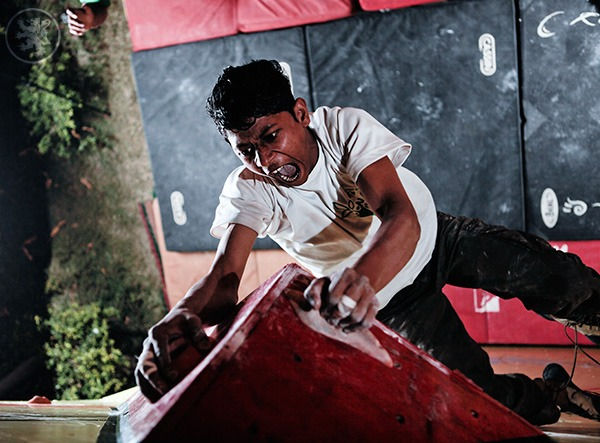
By 2005, 22-year-old Raju had worked already worked a decade as a carpenter. A a bright and eager learner Raju’s skill catches the attention of an architect, who’s site employed Raju. The architect recommends Raju to his climber brother- Abhitjit Burman (a.k.a. Bong), who was experimenting building climbing walls. Soon Raju helps Bong build a climbing wall for an annual competition.
Bong would go on to organize 11 open international bouldering competitions in Belapur, Navi Mumbai, under the umbrella of Girivihar, Mumbai’s oldest mountaineering club. Raju would go on to help him build a new wall at every competition.

2007 the International Federation of Sport Climbing (IFSC) is born, the world apex body charged with regulating competition climbing. Led by Marco Scolaris- an ex-climber, the IFSC gains credibility not only for high standards but its social values - universality, equal opportunities and transparency; an ethos that permeates extended climbing industry of equipment manufacturers, wall designers, etc.
2010-2020
This decade saw a surge in billionaires in India. Forbes India reported, in 2010 there were 69 billionaires in the country, by 2020 this number had more than doubled to a whopping 169 billionaires; highlighting the concentration of wealth in a fast-growing economy where 40 percent of the 1.2 billion population is impoverished.
This is also when our protagonists are forging their own success stories in the world of climbing. Their stories converge at the annual international bouldering competitions Bong was organising in Belapur (held from 2004-2014).
2010 Mani was consistently competing. Among the instructors at GETHNAA was Keerthi Pais, who took Mani under his wing. With Keerthi’s mentorship Mani continued competing and simultaneously began coaching young climbers and worked in outdoor camps; income useful to his family. Keerthi would later become Chairman of Sport Climbing, at the Indian Mountaineering Foundation (IMF)- India’s apex body for sport climbing.
2011 The first IFSC paraclimbing championships took place, in part, inspired by climbers like Philippe Ribiere from France. Philippe, was world renowned for his climbing prowess. It so happened he also had a severe physical disability. Philippe’s story lights a spark in Mani. He made up his mind to make it to the 2012 IFSC paraclimbing championships in Paris. Incredibly, he won gold! …making history as the first Indian to win an IFSC climbing medal!
2013 Both Mani and Phillipe are invited as special guest climbers at the annual competition in Belapur. Their presence inspires other competitors.


By 2010 Sandeep had competed in multiple regional and National and International competitions. Encouraged by his mentor Sreebash. he made his way to the annual Belapur competition. That year the Belapur competition was held on both natural and artificial surfaces. A seasoned competition climber on artificial walls, Sandeep discovered natural rock for the first time- and it reignited his passion for climbing. He would go on to travel all over India exploring and opening more than 500 bouldering routes.
2013 Sandeep, already inspired by Mani’s story- becomes the first Indian climber to compete in the regular IFSC World Cups circuit, competing in France, Austria, and Slovenia the same year.
By 2014 Raju and his team of carpenters were Bong’s regular collaborators. Bong bought the latest precision tools to better Raju’s craftsmanship. Together they had a built walls for nearly a decade for the annual bouldering competition at Belapur, perfecting their technique each year.
2015 The IFSC, was just eight years old. This fledgling sport body, built on the spirit of community and inclusivity was going to have their commitment to this ethos tested. The IFSC had bid to enter the Olympics; the proposal was under consideration by International Olympic Committee (IOC). Their decision was expected August 2016.
At the same time, IFSC received a bid from newcomer India to host a World Cup in May 2016. Should they accept? All eyes would be watching to see whether India is capable of hosting a World Cup to IFSC standards. Standards and good governance are matters IOC certainly cares about.
Trust built on decades of correspondence and cooperation wins over. IFSC accepts India’s bid to host the May 2016 World Cup. August 2016 - The IOC accepts IFSC’s bid to have Climbing be an official sport in the Tokyo 2020 Olympics.
2016 Raju and Bong build the climbing wall for India’s maiden IFSC World Cup. An IFSC technical delegate certifies the quality of the wall.


2020 onwards-
COVID. Enough said. Japan hosts the Tokyo 2020 Olympics in 2021.
2021 Faster, Higher, Stronger - Together; International Olympic Committee; IOC changes the Olympic motto that recognises the unifying power of sport and the importance of solidarity.
May 2025 Mani, now 39, just won silver at the IFSC Paraclimbing World Cup in Salt Lake City, Utah, USA. This brings his IFSC medal tally to a whopping 21!! He also runs his own climbing gym in Bangalore, Karnataka. Mani has his eyes set on the LA 2028 Olympics- where Paraclimbing will make its debut. His mentor Keerthi Pais is now the Vice President of IFSC- Asia.
2025 Sandeep, now 33 is still a passionate climber. He is filled with gratitude for the support he has received from the climbing community and is successfully paying it forward as one of the first entrepreneurs manufacturing climbing holds in India. On the side he finds time to mentor other underprivileged kids in Delhi.
2025 Raju is a successful contractor running large teams. His young daughter attends a reputed school in Navi Mumbai. He is keen to work with Bong on his next experimental venture…building a climbing academy for rural children in Maharashtra.
The 2025 IFSC World Cup circuit now includes first time host countries like Indonesia and Brazil. They successfully lobbied the IOC to have Paraclimbing in the 2028 Olympics.
Competition need not be only adversarial. Our protagonists and those around them serve to show what you can achieve by recognizing human potential, prioritizing kindness and solidarity… even in the context of competition. Here’s wishing them all continued, meaningful, success.


References:
“The World Champion we overlook” by Shyam G Menon, February 2020
The Socio-Cultural Practices of the Dorset Rock Climbing Community Towards the Local Environment, Yazan Abbas, Masters Research Thesis, Bournemouth University, 2019
“Urbanisation and Poverty in India, A statistical compendium 2010 “ issued by National Buildings Organisation, Ministry of Housing and Urban Poverty Alleviation, Govt. of India
“India makes more billionaires, but top 2 slip in list.” by Reuters, September 2010
“How India saw a billionaire boom in just 10 years.” by Koustav Das, India Today, March 2025
“Welfare of the urban poor cannot be an afterthought in economic growth plans” by Amarjeet Sinha, Indian Express, July 2022
drishtiIAS.com, news editorial, Urban Poverty 2022
**This article was originally published in the June edition of Pixel Sports (Print)


Gần đây thấy cái tên bắn cá đổi thưởng được nhắc đến tương đối nhiều trong các bài chia sẻ kinh nghiệm nên mình quyết định ghé qua quan sát. Ấn tượng đầu là nền tảng xử lý phần nhìn rất thông thoáng, bảng điểm số thể thao và không gian bàn cược live casino không bị trộn lẫn vào nhau. Phân khu dành cho các tựa game slot cũng được gom tụ chuẩn chỉ tại mỗi sảnh game. Trang web thể hiện một bố cục hợp lý, việc định vị các mục quan trọng rất trực quan và không gây cảm giác quá tải dữ liệu.
Nhìn chung 789club có bố cục rõ ràng và tập trung tốt vào phần nội dung chính. Mình đặc biệt thích cách các mục được phân chia bằng tiêu đề và khoảng trống thay vì sử dụng quá nhiều hiệu ứng. Giao diện vì thế trông đơn giản nhưng vẫn đủ thông tin cần thiết.
Điểm cộng đầu tiên khi bấm vào trang kèo trực tuyến là tốc độ load khá ổn, không bị giật lag hay delay khi chuyển tab. Giao diện thiết kế tối giản, dễ thao tác kể cả với người không sành công nghệ. Tuy nhiên để đánh giá tổng thể về độ uy tín thì chắc cần thêm thời gian kiểm chứng từ những người dùng trước.
Thấy xuất hiện nhiều trên các diễn đàn kqbd nên cũng vào nghía qua thử. Thiết kế tổng thể ổn, tone màu dễ chịu, thao tác phản hồi nhanh. Dù vậy vẫn giữ góc nhìn trung lập, đợi xem cộng đồng đánh giá thế nào về dịch vụ và độ ổn định lâu dài rồi mới quyết định.
Ban đầu chỉ định tò mò ghé qua trải nghiệm nhanh việc tải TK 88 chứ không có ý định đọc sâu. Thế nhưng giao diện lại gây ấn tượng tốt nhờ thiết kế thoáng mắt, các nhóm nội dung được phân chia thành từng khối rất dễ nhìn. Phần tiêu đề dựng to và rõ, chỉ cần lướt qua là nắm ngay ý chính của từng đoạn. Điểm cộng lớn nhất là bố cục phân bổ khoảng trắng hợp lý, không dồn nén chữ, chuyển đổi giữa các thư mục cũng mượt mà.