
Asia Cup 2025 Rajgir, Bihar: A Preview

The Hockey Asia Cup 2025 rolls into Rajgir, Bihar's world class stadium between August 29 and September 7, with the highest-ever stakes as the champion earns a direct place at the 2026 FIH World Cup in Belgium and Netherlands. The field of eight teams is drawn from two pools, with last year's winner South Korea getting challenged by Olympic bronze medallists India and revived Asian superpowers. The tournament consists of Pool A comprising India, China, Japan, and Kazakhstan, and Pool B with Malaysia, South Korea, Chinese Taipei, and Bangladesh.
India:
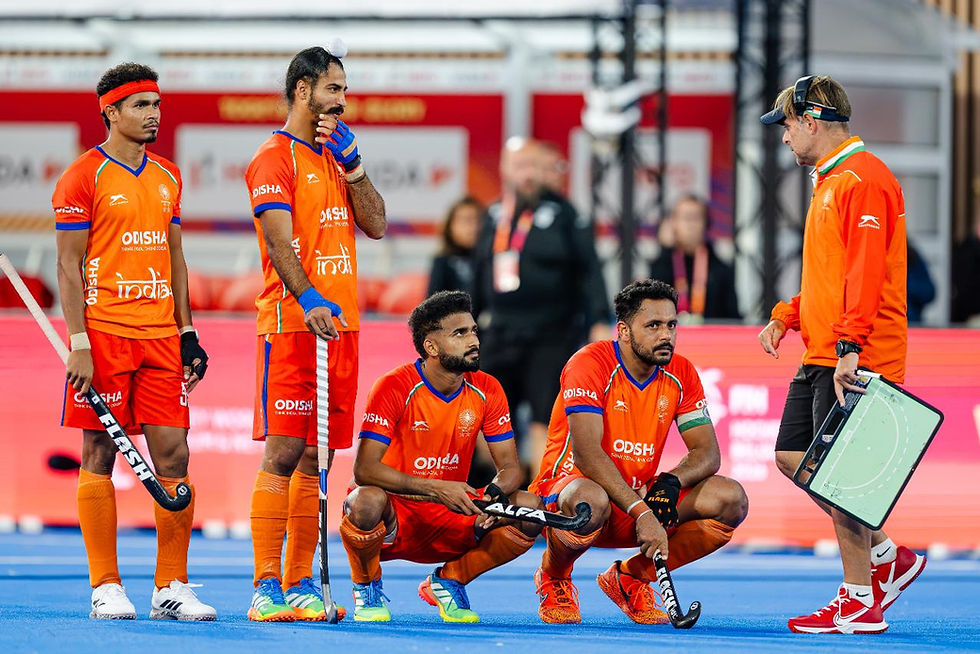
India comes in as strong favourites, 7th placed overall and toppers of Asian hockey. Led by goal-scoring captain Harmanpreet Singh with 203 goals from 236 games and 10 at Paris 2024 Olympics, they have an experienced 18 member team. A tactical change from their high-intensity gegenpressing to a more formal half court press format has been brought in by coach Craig Fulton with an emphasis on ball keeping and commanded build up play.
India's recent performance is a mixed bag. Having secured bronze at Paris 2024 Olympics, they fared poorly in the Pro League European leg, breaking their seven-match losing run with a 4-3 victory over Belgium in their last game. They have prepared through victory against Ireland (4-0, 2-1) and losses to Australia in the series of friendly games (3-1).
Key players: Harmanpreet Singh, Amit Rohidas, Vivek Sagar Prasad, Hardik Singh, Manpreet Singh, Krishan B. Pathak, Mandeep Singh.
India Rating: 8.5/10 - Good squad depth, seasoned leadership, home ground, and recent Olympic triumph ensure they are favorites to win despite Pro League woes.
China:
China comes into the Asia Cup placed 17th in the world, their highest ranking in several years. The squad has been transformed beyond recognition by the twin Australian coaching arrangement of head coach Cui Yingbiao, with huge contributions from the great coaches Alyson Annan and Ric Charlesworth who spearheaded a revolution in their women's squad. China adopt a steadfast defensive system with rapid counter attacks. Their tactic is to focus on ball retention and long patient build up play that tends to capitalize on penalty corner chances. The team has shown improvement in game management and tactical awareness under their current coaching setup.
China's men also looked promising in 2024, ending up in their maiden Asian Champions Trophy final, knocking Pakistan 2-0 for the semifinal only to be beaten by India. Such a break ended was an indication of gradually getting into competitiveness against the more traditional Asian giants. However, their recent form in 2025 has been mixed, as they lost to Austria in Nations Cup 1-3 and also to Oman 1-4, which indicates considerable vulnerabilities against the mid-tier opponents.
Key players: Guo Xiaoping, Ao Weibao, Du Talake, Caiyu Wang.
China Rating: 5.5/10 - Improved dramatically but variable performances against lower ranked opponents reveal weaknesses. Historic Champions Trophy semifinal promises much but requires consistency.
Japan:
Japan, 18th in the world, has consistent Asia Cup appearance with recent editions' fourth place finishes.
Indian Dutch coach Siegfried Aikman, of Dutch origin, has transformed Japanese hockey with innovative mental conditioning. His signature style involves teaching players to play Japanese chess on cell phones to improve abstract thinking and strategic planning. This method seeks to build "traps" for opponents rather than dependent on individual genius. Aikman prioritizes structured play over the Asian flair based hockey. His system concentrates on strategic placement, patience in building play, and taking advantage of opposition vulnerabilities with planned maneuvers instead of spontaneous displays of skill. The strategy is similar to that of chess, with players contemplating several moves ahead of time to set themselves up for better positions.
Their Asian Champions Trophy results include a second-placing finish in 2013 and 2021, as well as a third-place finish in 2023. Recent Nations Cup performances were less impressive, where they lost to Malaysia (1-2), Pakistan (2-3), and Wales (4-6), but beat South Africa 2-1.
Key players: Raiki Fujishima, Takashi Yoshikawa, Manabu Yamashita, Seren Tanaka, Kaito Tanaka, Koji Yamasaki.
Japan Rating: 6.5/10 - Strong tactical organization and skilled core give them competitiveness, but lack of firepower and recent inconsistent performances point to quarter-final limit.
Kazakhstan:
Kazakhstan debut in the Asia Cup as stand in replacements for Oman, an historic day for Central Asian hockey.
The nation has primarily focused on ice hockey development, where they rank 14th globally, but field hockey remains in its infancy. Kazakhstan's hockey heritage stems from their strong ice hockey program, which provides organizational structure and coaching expertise that can transfer to field hockey. Their ice hockey success suggests potential for tactical understanding and competitive mentality. The squad is shallow and inexperienced in international field hockey, with the majority of players moving from other stick sports or starting relatively recently. They have a largely domestically based squad with minimal experience of international standards of competition.
Kazakhstan's experience at the 2025 AHF Cup was worthwhile even if they finished fourth. They lost to Bangladesh (1-4), tied Thailand, and lost the third-place playoff 0-3 to Bangladesh. These scores identify the wide gap between their present standing and reputable Asian sides.
Key players: Dyussebekov Yerkebulan, Zhokenbayev Maxat, Yelubayev Aman, Aitkaliyev Altynbek, Yestemessov Rustam
Kazakhstan Rating: 3.5/10 - Totally new to this level with very little field hockey infrastructure. Ice hockey background gives some tactical base but huge skills deficit to bridge against more established sides.
Malaysia:
Malaysia are placed 12th in the world, their highest ranking in 18 years, after their impressive results in the UK.
Two-time Olympian Sarjit Singh Kundan (1984, 1992) became the chief in 2024 with a well-defined long term objective of the 2028 Los Angeles Olympics over short term gains. 62 year old ex captain, who played over 200 international matches, believes in patience and process driven rebuilding over quick fixes. Malaysia is in for a major transition following the retirement of major players, led by star drag-flicker Faizal Saari, whose exit left a huge tactical vacuum. The present team has a combination of veterans and young guns, and Sarjit steered clear of pressure by not fixing any particular Asia Cup goals. The team is at about 80% fitness for the Asia Cup after having undertaken seven weeks of hard training at the National Sports Institute. Sarjit's strategy is focused on defensive solidity and measured build-up play, responding to the loss of Saari's penalty corner threat by creating new ways to score.
Malaysia's hockey legacy boasts Asia Cup regular competitiveness with runner up finishes in 2017 and 2022, along with several fourth place finishes. Their previous Olympic participation was Sydney 2000, when Sarjit led the team, so the qualification to 2028 LA Olympics is an extremely personal goal for the present coach. Recent results indicate improvement as Nations Cup wins over Japan (2-1) and South Africa were achieved, although heartbreaking losses to New Zealand (3-4) and draws against Pakistan (3-3) were also suffered.
Key players: Marhan Jalil, Razie Rahim, Firhan Ashari, Faiz Jali, Azuan Hassan, Shahril Saabah, Ramadan Rosli.
Malaysia Rating: 6.5/10 - Good coaching background and incremental development path balanced by squad transition issues and loss of core players.
South Korea:
South Korea comes in as reigning Asia Cup champions, having won their record fifth title in 2022 with a 2-1 win over Malaysia in Jakarta.
This achievement under coach Sin Seok-gyo represented a remarkable resurgence for Korean hockey, which had struggled in the previous decade. South Korea currently ranks 13th globally, maintaining their position as the second strongest Asian team behind India. Their recent tournament record demonstrates consistent competitiveness, including being the only Asian team to reach the 2023 World Cup quarter finals. Sin Seok-gyo uses a structured approach that balances firm defensive organization with swift transitional play. The methodology relies on disciplined positional play and taking advantage of counterattacking chances.
South Korea's 2024-2025 performance has been inconsistent but competitive. They beat China in the semifinals of the Asian Champions Trophy, only to be defeated by India in the final. Recent performances involve victories over Malaysia and draws with top-level opponents, indicating sustained competitiveness despite team development.
Key players: Lee Nam-yong, Jang Jong-hyun, Kim Jae-hyeon, Jung Man-jae, Yang Ji-hun.
South Korea Rating: 8.0/10 - Past champions with established tournament prowess, veteran coaching, and habitual world class consistency establish them as top title contenders.
Chinese Taipei:
Chinese Taipei is in their first big continental tournament, ranked approximately 40th on the international stage for field hockey.
The squad has experience from ice hockey competitions but has a tall order to climb to reach the elite standard of the outdoor game. Under head coach Huang Jen-hung and assistant Chen-guang Hsieh, Chinese Taipei has invested in building a younger team with an average age of 22.71 years. The coaches stress technical improvement and tactical discipline to make up for physical handicaps.
Chinese Taipei’s men’s team showed resilience and flashes of promise during the 2025 AHF Cup qualifiers in Jakarta where they secured a historic 2–1 win over Uzbekistan thanks to two goals from Wu Chih-suan, narrowly lost 1–0 to Indonesia behind Chen Yi-ming’s eight clearances and three blocks, and were edged 3–2 by Thailand despite captain Huang Jen-hung’s lone assist and 85% passing accuracy.
Key players: Huang Jen-hung, Wu Chih-hsuan, Lee Kuang-cheng, Chen Yi-ming, Tseng Wei-hao.
Chinese Taipei Rating: 4/10 - Restricted international experience and physical disadvantage against more established teams. Technical ability and organization give basis but large deficit to elite Asian level.
Bangladesh:
Bangladesh comes into their inaugural Asia Cup as 2025 AHF Cup champions, representing a historic milestone for the 31st ranked country in the world.
This is their best ever continental performance and a great improvement from their earlier 38th ranking.
Head coach Golam Mortuza lays stress on organized defending and swift transitions. The team has picked up improved game management skills, which can be seen in the ability to close out close matches in the AHF Cup. Former player Imran Hassan Pinto lays stress on long term planning to achieve the top rungs of Asian hockey. Bangladesh's victory in the AHF Cup was dominating, beating Kazakhstan 4-1, Indonesia 3-2, Thailand 2-1, and Sri Lanka 5-0 in pool play before falling to Oman 4-5 in the semifinals and taking third place with a 3-0 win over Kazakhstan.
Most notable players: Rezaul Karim Babu, Ashraful Islam, Biplob Kujur, Roman Sarkar, Obaidul Hossain Joy, Fazle Hossain Rabbi.
Bangladesh Rating: 5.5/10 - Win in AHF Cup gives huge confidence boost, but transition to elite level of Asian competition poses huge challenge. Better organization and recent competitive campaign are pluses.
Tournament Outlook:
Pool A has India's home ground advantage against China's re-emergence, Japan's tactical approach, and Kazakhstan's inaugural appearance. Pool B has defending champions South Korea against Malaysia's rebuilding effort, Bangladesh's first-ever appearance, and Chinese Taipei's upset mentality.
The competition format advances from pool competition (August 29-September 2), Super 4s phase (September 3-5), and knockout finals (September 6-7). With World Cup qualification on the line, each game holds enormous importance for the future growth of Asian hockey.
Look for India and South Korea to sweep their own pools and Malaysia and Japan vying for the last Super 4s spots. The champion will do Asia proud at the 2026 World Cup and thus make this Rajgir tournament a defining moment for the hockey aspirations of the continent.


Comments