
India Victorious: Simply Progress or Paradigm Shift?
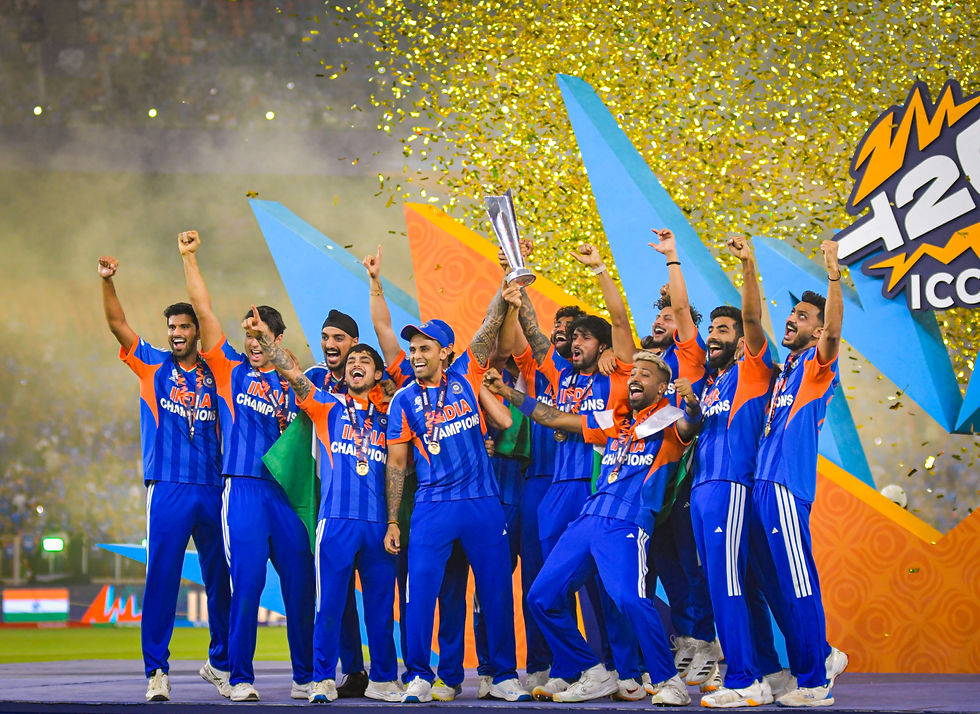
Photo by Subham Mondal
When a team starts by scoring 92 runs in the first powerplay of any T20 match, the bowling team is always bound to play catch up. If we add a few more factors to that – the pressure of the World Cup final; the constant noise of a more than 100,000 strong crowd; facing the overwhelming favourites and defending champions – more than daunting, the task looks impossible on paper. The Kiwis would testify that it was impossible in practice as well. As the bowling attack crumbled under the onslaught of India’s famed top 3, India reached the 200 run mark in the 15th over and looked well on course of posting a 275+ total in a home World Cup final. After an impressive Jimmy Neesham over where he struck thrice, the Kiwis looked to finish with momentum and restrict India under 240. This would give them an outside chance. After all, England had lost the semi-final by only 7 runs even after India scoring a mammoth 253. But the late onslaught ensured India went past their semi-final total to post 255.
The target never looked achievable unlike the semi-final match. New Zealand lacked a Bethel-like innings from their top order. Allen failed to build on his 33-ball century in the semi-final and fell cheaply. Seifert tried to put up a show but crumbled under the increasing pressure created from a lack of support on the other end. In a fitting manner, the best figures were posted by a certain Jasprit Bumrah with 4 for 15 in his 4 overs, making him the highest wicket taker in the tournament alongside Varun Chakravarthy. But a look at the economy rate would tell the whole story. All teams were essentially playing an 18-over game against India as Bumrah has consistently delivered 10–12 dot balls in most of his outings in this World Cup.
The story of the final is a fitting climax to an epic that has been just a little over 2 years in the making now. India’s three previous World Cup winning captains – Kapil Dev, M S Dhoni, and Rohit Sharma – were cricketing giants carrying the expectations of a nation often single-handedly. Surya Kumar Yadav is a different story as a captain altogether. He started off late on the international stage. He plays mostly in the 20-over format and has become a great of the format only in his 30s. Someone like Subhman Gill fits the bill of an Indian captain historically speaking. An Under-19 champion, dashing with the bat, smashing the hoardings with his swagger off the field – yet he was not given the 20-over captaincy. Rather, he was dropped from the World Cup squad to pick Ishan Kishan based on his Syed Mushtaq Ali Trophy performance.
The Gautam Gambhir effect on this team has been undeniable. The success stories of the team almost exclusively owe their allegiance to the non-celebrity culture that GG has been arguing for ever since he came into the Indian set-up after the 2024 World Cup triumph. IPL was supposed to give Indian cricket a definitive edge in the T20 format. But surprisingly, India had won their sole T20 World Cup title before 2024 in the pre-IPL era. Somehow, the domestic glory was not translated onto the international stage. Gautam Gambhir, on the other hand, has built his leadership reputation completely on his success in T20 cricket. While no one can question his laurels as a Test and ODI batter for India, he never got the chance to lead the nation on the field. But he ensured a total turnaround for KKR starting 2012 after their dismal performance in the initial years. GG has often proclaimed that his biggest regret as the KKR captain was not to back Surya Kumar Yadav more and to allow him to leave KKR for Mumbai Indians. So when he was made the coach, succeeding the successful era of Rahul Dravid, no wonder he made Surya the captain against many rooting for Hardik Pandya as the more probable option.
The following two years have been nothing short of total domination shown by India in the white-ball format. They have won 32 out of the 34 matches in their last four global white-ball tournaments. Both at Ahmedabad – the 2023 fifty-over World Cup final and the Super 8 match against South Africa in this World Cup. In the process, they have won two T20 World Cups, one Champions Trophy and one Asia Cup. The protagonists of these victories play a team game. A Sanju Samson remains on the fringes of the squad for most of it and comes back to get his chance in the middle of the World Cup to play three knocks in the 80s and 90s without caring for his century. Becomes the top run scorer and the player of the tournament in the process. A certain Ishan Kishan forces his way into the squad and plays some of the most exciting knocks of the tournament. Abhishek Sharma remains out of form following an illness at the start of the tournament to play a blinder in the final. Shivam Dube and Tilak Verma chip in with small yet extremely vital knocks in crucial times. Hardik Pandya and Axar Patel put up an all-round display with bat, ball and most crucially on the field to ensure perfect balance to the team. Needless to say, the catches taken by Axar Patel in the semi-final are some of the best ever. Varun and Arshdeep have done their bit with the ball but who can look past Bumrah – the generational bowler who has cemented his cry of being counted in the bracket of the best ever across formats.
All World Cup victories have always come through team effort. But there have been individuals equated with the triumph. The 2026 victory somehow feels different for its multiplicity of micro-narratives. This paradigm shift in Indian cricket obviously has its flip side as well. India has struggled miserably in the red-ball format, suffering whitewash against New Zealand and South Africa for the first time in history at home. The white-ball venues have also been favourable for India in the last 4-year cycle. They have played two tournaments at home, two in Dubai and one in the West Indies. However, the next two years will see a 50-over World Cup hosted by Namibia, Zimbabwe and South Africa in 2027 and a T20 World Cup hosted by Australia and New Zealand in 2028. All these conditions will offer a lot of pace and bounce. It remains to be seen whether this change in approach can survive the onslaught of this change in conditions.
But nothing can erase the absolute dominance imposed by India in white-ball cricket in this third decade of the 21st century. It must be seen as a dominance at par with the West Indies of the 70s, the Australian domination of the late 90s and early 2000s. A dominance that has seen many protagonists and changes in approach. But none probably as different in the history of Indian cricket as the one created by the duo of Gautam Gambhir and Surya Kumar Yadav.


Comments