
FIH Hockey World Cup: Another World Cup, The Same Questions
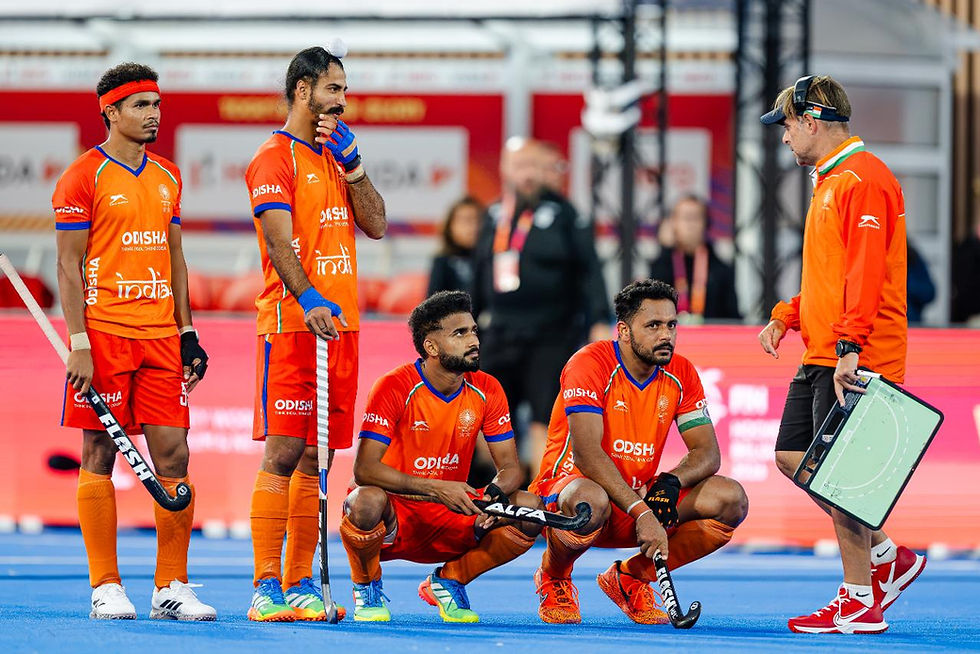
Image: Hockey India
India came to the World Cup hoping to establish themselves among the best teams in the world. They left Belgium and the Netherlands in eighth place. The result was disappointing, but more worrying was how familiar some of the problems looked.
Indian men’s hockey has reached an interesting point. Winning against Asian teams is no longer enough. Beating Pakistan still matters and winning the Asia Cup deserves appreciation. But this is a team that has won medals at the last two Olympic Games.
The expectations have changed. India are no longer trying to prove that they belong among the better hockey nations. They have already done that. The question now is whether they can consistently beat the very best. At the 2026 World Cup, the answer was again no.
India finished eighth after a campaign that produced two wins, three defeats and a draw before losing the final classification match against Belgium in a shootout.
There were good moments. There were goals. Harmanpreet Singh once again showed his quality from penalty corners. Sukhjeet Singh and Abhishek had their moments in attack. But when the tournament demanded India's best hockey, the team could not produce it consistently. And that should concern Craig Fulton and his coaching staff.
India started with a 3-1 victory over Wales. It was the result everyone expected. Sanjay opened the scoring from a penalty corner and India had enough control to begin the tournament with three points. Harmanpreet Singh was named Player of the Match. There was nothing particularly worrying about the opening game, but there was also little reason to get carried away.
The real examination was always going to come against England. It arrived two days later.
The 4-2 defeat against England was the first warning. England were quicker in important areas and much more effective when opportunities arrived.
India had possession and attacking moments, but international hockey at this level is not decided by how often you look dangerous. It is decided by what you do inside the two circles. England were better there.
India now had to beat Pakistan, and preferably beat them well.
India responded. The 5-3 victory against Pakistan was entertaining and important. Abhishek was named Player of the Match and India's attacking quality was visible.
But there was another side to the scoreline. India conceded three goals. Against a Pakistan side that England had beaten 4-1, those three goals mattered. England then defeated Wales 8-2.
That left India behind England in the pool and sent them into the next phase carrying a difficult situation. This is one of the realities of modern tournament hockey.
If India wanted to reach the semi-finals, they were eventually going to have to beat one of the world's elite teams.
The Netherlands provided that test. India lost 3-1. There is no shame in losing to the Dutch. They are one of the strongest hockey teams in the world. But for India, these are precisely the matches that now have to become competitive victories rather than respectable defeats.
After two consecutive Olympic medals, the benchmark cannot remain simply competing well against the Netherlands, Germany, Belgium and Australia. India need to beat them regularly.
The Netherlands defeat left India with almost no margin for error. Argentina became a must-win match.
If one match summed up India's World Cup, it was the 5-3 defeat against Argentina. India needed to win. Instead, they were behind after just 39 seconds.
That is unacceptable in a match of such importance. Joaquin Toscani scored almost immediately and Nicolas della Torre soon doubled Argentina's advantage from a penalty corner.
India were suddenly chasing the game. Sukhjeet Singh pulled one back in the 10th minute and offered some hope. But India never really gained control. Tomas Domene restored Argentina's two-goal advantage after half-time. Another Indian defensive error resulted in a penalty stroke, which Domene converted.
By the time Lucas Toscani made it 5-1 in the final quarter, India's World Cup dream was effectively over. Sukhjeet scored again late in the game and Hardik Singh converted a penalty stroke. The final score became 5-3. But those late goals changed very little.
India had conceded five goals in a match they absolutely had to win. That is the most worrying part. This was not about missing one penalty corner or losing through an unlucky deflection. India were beaten because Argentina were sharper, more clinical and punished mistakes. For a team with India's ambitions, conceding five in a must-win World Cup match has to bring serious questions.
Harmanpreet Singh finished the tournament with eight goals. All eight came from penalty corners. That statistic tells two stories. The first is positive. Harmanpreet remains one of the world's great drag-flickers. When India win penalty corners, they possess a genuine match-winning weapon.
But there is another question. What happens when Harmanpreet doesn't score? India cannot continue expecting their captain to solve every difficult match from penalty corners.
The best teams have goals coming from everywhere. They have forwards who convert half chances. Midfielders arrive inside the circle. Penalty-corner variations create uncertainty. Rebounds are attacked aggressively.
India certainly have talented forwards. Abhishek has the speed and individual ability to trouble any defence. Sukhjeet showed his finishing quality, particularly against Argentina. There is plenty of attacking talent around them. But talent and consistent international output are different things.
India need more goals from open play when matches become tight. Because opponents already know India's biggest weapon. Win a penalty corner. Harmanpreet steps up. The challenge is building an attack that remains equally dangerous when that option is taken away.
The other major concern is at the opposite end. India conceded four against England. Three against Pakistan. Three against the Netherlands. Five against Argentina. And three against Belgium. That is too many goals for a team hoping to win a World Cup medal.
Modern hockey is fast and high-scoring, so clean sheets are difficult. But there is a difference between conceding because an opponent produces something exceptional and conceding because your defensive structure breaks down.
Against Argentina, some of India's problems were self-created. Players were caught out of position. Decision-making under pressure was questionable. Argentina found spaces that should not have been available in such an important match.
The first goal arriving after only 39 seconds was particularly damaging. When you enter a must-win match, the first objective should be to settle into the contest. India were chasing it almost immediately.
Once that happens against a quality team, your tactical plan changes. You push more players forward. Spaces appear behind. The opponent gets opportunities in transition. That is exactly the type of match Argentina wanted.
There is another issue that sometimes gets lost between discussions about penalty corners and defending. The best teams can slow a match down when necessary and then suddenly increase the tempo.
India are excellent when a game becomes open. The speed of players such as Abhishek can be devastating in transition. But World Cups are not won only through transition hockey.
There will be periods when you have to keep possession, move the opposition, control the centre of the pitch and wait for an opening. There will also be periods when the opponent has momentum and you simply need to kill that momentum for five minutes.
That game management remains an area where India can improve. Against the strongest European sides and Argentina, possession without purpose does not help. The ball has to move the opponent. Circle entries have to lead to genuine chances.
And when possession is lost, the team has to recover its defensive shape quickly. That connection between midfield and defence was not always convincing during this World Cup.
To India's credit, the team did not simply disappear after the semi-final dream was over.
The seventh-eighth place match against Belgium finished 3-3. Belgium were playing at home and remain one of international hockey's strongest teams. India fought until the end.
With less than half a minute remaining and India trailing 3-2, Harmanpreet stepped up once again. He converted the penalty corner — 3-3. That showed character. India eventually lost the shootout 4-3 and therefore finished eighth.
It was a disappointing position, but the Belgium game at least showed that this team still had fight after the emotional disappointment of missing the semi-finals. The problem is that India should not have been playing for seventh place in the first place.
Perhaps the World Cup performance should not have come as a complete surprise. India's performances in the FIH Pro League over recent seasons had already provided warning signs.
Craig Fulton experimented with his squad and used a large group of players during the 2025-26 Pro League. There were some excellent results towards the end, including victories over Germany and the Netherlands.
Those results showed the ceiling of this team. On their day, India can beat anybody. But that phrase "on their day" is exactly the problem.
World champions do it repeatedly. Olympic champions do it repeatedly. India's challenge is consistency.
One great victory over Germany cannot be followed by an ordinary performance in the next major game. A win against the Netherlands in the Pro League means very little if you cannot reproduce that level when you face them at a World Cup.
Tournament hockey rewards consistency much more than occasional brilliance.
Craig Fulton has achieved plenty with India and deserves credit for that. But coaching at this level also means being judged by major tournaments. India arrived at this World Cup as a team with genuine medal ambitions. They finished eighth. That demands analysis.
Why did the defence concede so regularly? Why was India unable to control crucial periods against the strongest opponents? Why does the attack still look heavily dependent on Harmanpreet's penalty corners? Why did India start a must-win match against Argentina so poorly? And perhaps most importantly, why does this team still struggle to reproduce its best hockey consistently?
These are not questions that should be asked because of one bad tournament. They should be asked because India have enough quality to expect more.
India won the 2025 Asia Cup in Rajgir. They were excellent during that tournament and deserved the title. But Indian hockey has moved beyond measuring itself only against Asia. That is actually a compliment to how far the team has come.
The standard now has to be Germany, the Netherlands, Belgium, Australia, England, Spain and Argentina. Germany won this World Cup. Spain reached the final. Argentina reached the semi-finals. The Netherlands reached the semi-finals. India finished eighth. That is the gap that matters.
Beating Pakistan 5-3 will always bring satisfaction because of the history of the rivalry. But Indian hockey cannot judge a World Cup campaign by the Pakistan result.
The bigger question is what happened against England, the Netherlands and Argentina. India lost all three. That is where the tournament was lost.
There is no need for panic. India have not suddenly become a poor hockey team. There is too much quality in this squad for that. Harmanpreet remains world class from penalty corners. Abhishek can change matches. Sukhjeet continues to develop as an important attacking player. Hardik Singh brings enormous quality to midfield.
India have experience, athleticism and depth. The foundations are there. That is precisely why eighth place should hurt. India should expect more.
The World Cup exposed problems in defensive organisation, consistency, game management and attacking dependence on penalty corners. Those problems are fixable. But first, they have to be acknowledged.
The next Asian Games will inevitably bring another opportunity to win gold. And if India do win, it should be celebrated. But Asian gold cannot erase what happened at this World Cup.
Indian hockey has already proved that it can dominate Asia. The next step is much harder. It has to become a team that Germany, the Netherlands, Belgium and Argentina genuinely fear playing in the biggest matches.
Two consecutive Olympic medals raised the standard. India cannot lower it now.
Eighth in the world is not a disaster. For this Indian team, however, it is simply not good enough.


